14 Nov
Measurement Guidelines for an Airline-Approved Pet Carrier
Given how close our pets are to us, it is no surprise we’ve tried to make every facet of their life as comfortable as ours. This is especially true for pet travel accessories; while you may not have much in the way of choice earlier, you can find a plethora of options when it comes to pet travel essentials.
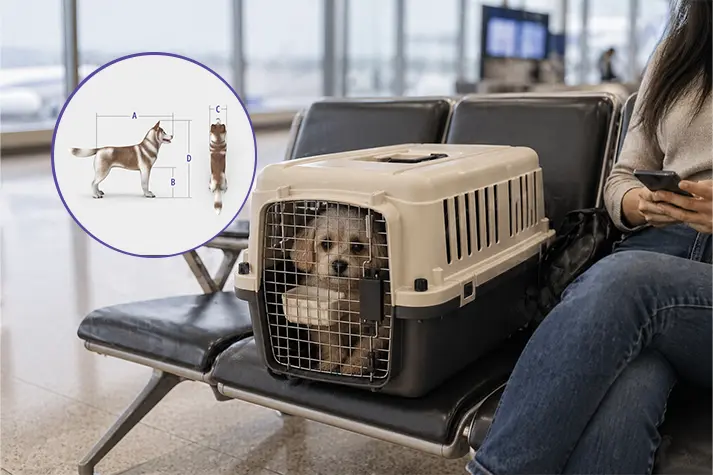
Among these essentials is an IPATA approved pet travel crate . Much like any other product, you have plenty of options when it comes to the design, construction, and form factor of a pet crate. However, these differences are due to the different ways a pet crate is used worldwide, so it is important to know how you'll be using a pet crate before purchasing one.
For travel by road or short distances, there are plenty of options, with the most defining factor being whether it is sized properly. However, for international or air travel, things are more structured. Crates must comply with safety standards set by the International Air Transport Association (IATA), which most pet friendly airlines follow, often with additional requirements of their own.
Before selecting a crate, the first step is accurate pet measurement. Here’s how to do it correctly.
How to Measure Your Pet for a Crate
Before buying a crate, you need to ensure it will be comfortable and safe for your pet. A crate that is too small can restrict movement and airflow, while one that is too large may not be accepted by airlines. So, for this you need to understand how to measure your pet correctly.
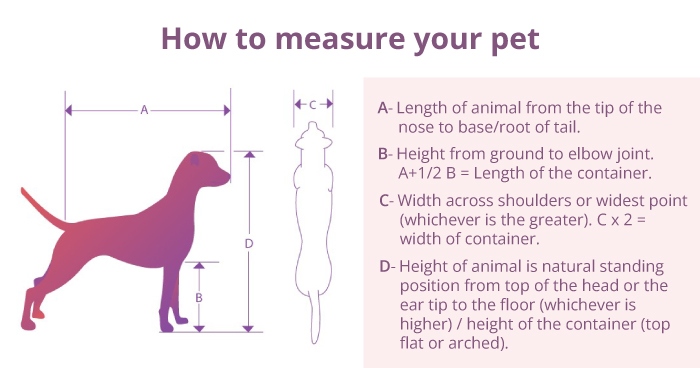
A = Length of animal from nose to the root (bony tip) of their tail
B = Height from ground to elbow joint
C = Width across shoulders
D = Height of the animal in a natural standing position from the floor to the top of the head or ear tip
How to Calculate the Internal Volume of a Crate
Provided your pet isn’t a snub-nosed/flat-faced/brachycephalic breed, you can use these formulae to calculate the Length x Width x Height of your soon-to-be-bought pet crate. If your pet is a snub-nosed/flat-faced/brachycephalic breed, follow these formulae and choose one size larger than your measurements to ensure adequate ventilation.
- Length = A + ½B
- Width = C x 2
- Height = D + 3 inches
Example Calculation
To make things easier, here’s a simple example:
If your dog’s measurements are:
A = 60 cm, B = 25 cm, C = 30 cm, D = 50 cm
Then:
- Length = 60 + 12.5 = 72.5 cm
- Width = 30 × 2 = 60 cm
- Height = 50 + ~7.6 cm ≈ 58 cm
This gives you the minimum internal crate size required.
Construction of a Pet Crate
Comfort and safety go hand in hand when travelling with your pet. A crate must be both secure and well-ventilated to handle the conditions of air travel.
According to IATA guidelines, an airline-approved crate must meet the following:
- Made of rigid plastic, solid wood, plywood, fibreglass, or metal
- Roof and floor must be solid and leak-proof
- Door must form one entire side and be securely fastened
- Ventilation must be present on all four sides (for international travel)
- No part of your pet should be able to protrude outside
- Ventilation openings must not exceed:
- 25 mm × 25 mm for dogs
- 19 mm × 19 mm for cats
- All parts must be secured with metal nuts and bolts (plastic clips alone are not accepted)
- Interior must be smooth with no sharp edges or protrusions
- Two food and water bowls must be attached inside and accessible from outside
Additionally, absorbent bedding is now commonly required to manage waste during transit.
Airline-Specific Requirements You Should Know
While most airlines follow IATA guidelines, many have introduced stricter rules. Carriers such as Emirates and Lufthansa are known to enforce additional checks.
- Pets must be able to stand naturally without ears touching the top
- The crate must allow the pet to turn around comfortably
- Snub-nosed breeds may require larger crates or additional documentation
- Crates with weak locking systems or insufficient ventilation are often rejected
Because of these variations, consulting a professional pet transport service can help ensure compliance and avoid last-minute issues.
Additional Travel Tips
While these are not IATA-issued guidelines, these general tips will help make your journey smoother:
- The crate must have additional room for the pet to sit, stand, lie or turn around comfortably.
- The crate must be strong, sturdy and secured by a proper locking system.
- The crate must have LIVE ANIMAL stickers pasted on the top and sides in letters that are at least 1 inch tall.
- The crate must have continuous ventilation minimum on two sides (for domestic travel) and all four sides (in case of international travel)
- The crate must have LIVE ANIMAL stickers pasted on the top and sides in letters that are at least 1 inch tall.
- The crate must have LIVE ANIMAL stickers pasted on the top and sides in letters that are at least 1 inch tall.
- The crate must have its pet's details and owner's contact information.
Common Mistakes Pet Parents Make
Even with the right intentions, small errors can lead to travel delays or rejection at the airport:
- Choosing a crate based on weight instead of size measurements
- Ignoring ear height while measuring
- Using soft carriers for cargo travel
- Not securing the crate with metal bolts
- Underestimating airline-specific restrictions
- Selecting a crate that doesn’t allow proper airflow
Final Thoughts
Choosing the right crate is one of the most important steps in preparing your pet for air travel. Accurate measurements, the right crate size, and compliance with airline and IATA guidelines can make a significant difference in ensuring a safe and stress-free journey.
Since airline requirements can vary and are often stricter than standard guidelines, it’s important to get every detail right before travel.
If you’re unsure about crate sizing, airline approvals, or documentation, working with a professional pet transport service can simplify the process. From selecting the right crate to ensuring compliance with airline-specific rules, expert guidance can help you avoid last-minute issues and ensure your pet travels safely and comfortably.
FREQUENTLY ASKED QUESTIONS &
What size pet carrier is allowed on international flights?
Most airlines follow IATA guidelines, where crate size is calculated using your pet’s measurements. However, airlines may require slightly larger crates depending on breed and route.
Can my pet touch the top of the crate?
No. Airlines generally require that pets stand naturally without their ears touching the top. If they do, the crate may be rejected at check-in.
Are soft carriers allowed for air travel?
Soft carriers are usually allowed only for cabin travel (depending on airline rules). For cargo travel, a rigid, airline-approved crate is mandatory.
What happens if my crate is not airline-approved?
If the crate does not meet requirements, your pet may be denied boarding. This can result in delays, rescheduling, or additional costs.
Do snub-nosed breeds need special crates?
Yes. Brachycephalic breeds often require larger crates with better ventilation, and some airlines may impose additional restrictions for safety reasons.
Do all airlines follow the same pet travel crate rules?
While most airlines follow IATA standards, many have their own additional rules. It’s always best to check with the airline or a professional service before travel.




AUTHOR’S BIO
Carry My Pet
Passionate pet enthusiasts and globetrotters, dedicated to easing furry friends' journeys worldwide. Penning tales of compassion at CarryMyPet, where every relocation is a tail-wagging adventure.